Large Behavioral Models: Foundation Models over User Event Sequences
Abstract
Foundation models changed language by replacing one model per task with a single pretrained model that adapts to many tasks. This talk argues that the same shift is reaching behavioral data, the timestamped sequences of purchases, payments, and app interactions that people leave behind, and sets out what a foundation model for behavior has to demonstrate: zero- and few-shot transfer to unseen catalogs and user populations, breadth from a single checkpoint, and generality that improves with scale.
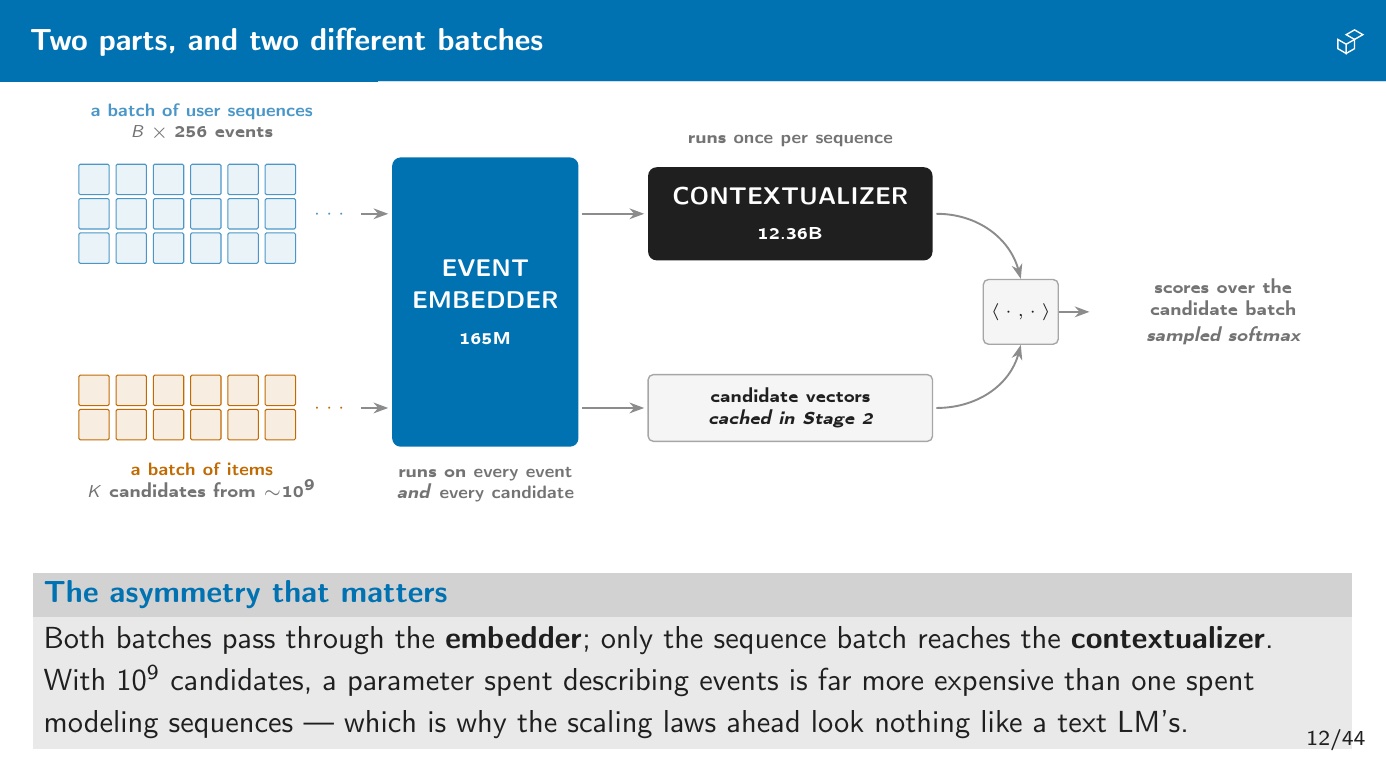
We review why most industrial behavioral models to date are trained and evaluated within a single platform, and describe the approach behind BehaviorGPT-v4, a 12.5B-parameter Large Behavioral Model that represents each event by its multimodal features rather than an item ID and ranks a full catalog in one forward pass. On a held-out public benchmark, no baseline reaches its zero-shot accuracy even after 2.9M target samples, and across eight data streams it leads the strongest specialist trained on each corpus in 31 of 32 cells.
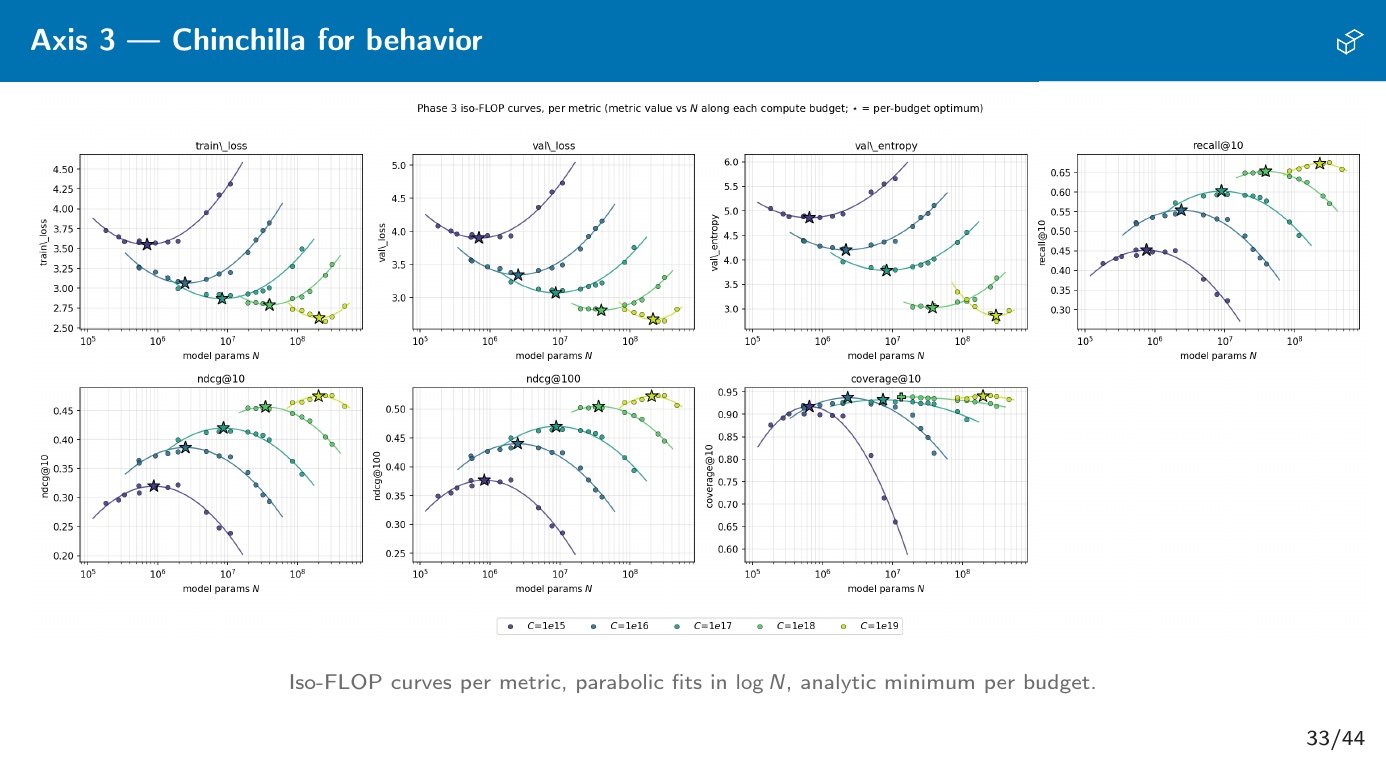
The second half presents scaling laws from roughly 600 training runs spanning 1015 to 1019 FLOPs: the compute-optimal event embedder holds about 2% of parameters at every budget, the compute-optimal model size grows as C0.62, the critical batch size varies threefold across metrics, and the choice of evaluation metric is itself part of the scaling law.
Outline
- The claim. What a foundation model for behavior would have to demonstrate.
- Why it has not happened yet. Including at the seven institutions that have each built one.
- Approach. Enough of the model to make the results legible.
- Evidence. Benchmarks, breadth, and A/B tests, and what each of them does not establish.
- Scaling laws. What scale buys, on four axes and ~600 runs.
- Conclusions. And where this goes next.
These are the slides as presented on August 27, 2026. Some results have been updated since.
Related paper
The scaling-law half of the talk is written up in Scaling Laws for Behavioral Foundation Models over User Event Sequences.
Citation
@misc{bruelgabrielsson2026lbmtalk,
  author       = {Rickard {Br{\"u}el-Gabrielsson}},
  title        = {Large Behavioral Models: Foundation Models over User Event Sequences},
  howpublished = {Invited talk, JPMorgan AI Research},
  year         = {2026},
  month        = aug,
  note         = {Presented August 27, 2026},
  url          = {https://research.unboxai.com/large-behavioral-models-invited-talk-at-jpmorgan-ai-research.html},
}