Language modeling had two breakthroughs. First, one pretrained model, fine-tuned per task, replaced task-specific systems. Then scale made the fine-tuning optional. Models of human behavior are still built one dataset, one task, and one company at a time. BehaviorGPT-v4 brings both breakthroughs to behavior.

12.5B
parameters
150B
user actions
3.6T
tokens
3
industries, one checkpoint

BehaviorGPT-v4 is a Large Behavioral Model pretrained on purchases, app sessions, and payments. To our knowledge, both the model and its training corpus are the largest yet disclosed for behavioral data. A single set of weights serves all three industries and ranks well on datasets it has never seen. This post summarizes our technical report.

Key results
  • Zero-shot, it beats trained specialists. On public datasets held out from pretraining, BehaviorGPT-v4 with no samples from the target outranks specialists trained on the target's full training split.
  • One model, 30 of 31 pairs. Without adaptation, one checkpoint leads the strongest baseline on 30 of 31 dataset–task pairs across three industries. Fine-tuned where we adapted it, it leads all 31.
  • Gains 17 times more from added data. Fine-tuned, each tenfold increase in target data raises its accuracy 17 times as much as the strongest baseline's.
  • Under a millisecond. It ranks a full catalog in one forward pass, in under a millisecond per request (benchmark throughput), 48 times faster than a prompted LLM ranking only a 1,000-item shortlist.
  • In production. In A/B tests against incumbent systems, BehaviorGPT models have raised conversion and orders by double-digit percentages in several deployments.
The problem

Behavior is still modeled one dataset at a time

In retail, app engagement, and payments, most of what gets logged is behavioral: records of what people did, rather than what they wrote or photographed. Behavioral foundation models have reached industry at Meta, Netflix, Shopify, Revolut, Nubank, Visa, and others. Each is pretrained on one company's event stream and evaluated on that company's own tasks. Academic work has shown zero-shot transfer across catalogs, but at 10−5 to 10−4 of our pretraining scale, on public recommendation data from a single industry, and almost always for next-item prediction alone.

So the pretrained behavioral model has mostly served as a feature extractor, with a new head fitted for every task on every platform. We know of no model that had shown breadth across industries, catalogs, and tasks at the same time. We set out to test whether the three properties that made language models foundation models also hold for behavior:

  1. Zero-shot transfer. The model ranks well on a new merchant, catalog, and user population with no samples from that dataset.
  2. Breadth from one model. One fixed set of weights competes with the strongest specialist across industries and tasks, all at once.
  3. Generality that grows with scale. Larger models transfer better zero-shot and need less target data.
The model

What BehaviorGPT-v4 is

BehaviorGPT-v4 predicts a person's next action from their past actions in chronological order, as a language model predicts the next token. It has 12.5B non-embedding parameters and was pretrained on 150 billion actions (3.6 trillion tokens) from retail, engagement, and payments: 1.5 times the largest published event count and 1.8 times the largest published token count.

Each action enters the model through its features: description text, images, categories, price, time, and place. The model does not rely on item IDs, so it can rank items, and whole catalogs, that it has never seen. Adding a new item takes one pass over its features, with no retraining. Every task is posed the same way, as the next action given the context that defines it, so one checkpoint serves search, recommendations, and payments without a head fitted per task.

Language as a special case. The model's structure contains the language model as one instance: let every event be a single token, the embedder a lookup table, and the candidate set a fixed vocabulary, and the model becomes a decoder-only transformer trained by next-token prediction. A Large Behavioral Model lifts both restrictions: events are described by open-ended text, imagery, and numbers, and the model predicts a distribution over any catalog, including one never seen in training. The reduction also runs the other way. Because candidates are embedded from their features, a candidate set can hold anything the embedder can describe (a complete answer, a query, a multimodal action), so any task whose answers can be enumerated becomes a single step: one forward pass and one product against cached candidate vectors, where an LLM would decode its answer token by token.

Training proceeds in two stages. The model first learns to embed events, then freezes the embedder, so every candidate vector can be precomputed and cached for both training and serving. A custom kernel computes an exact softmax over catalogs of up to a billion items. The model also keeps a separate softmax for each data distribution, which aligns the representations of different industries instead of teaching the model to tell them apart. In a smaller-scale ablation, adding out-of-industry data helped only with separate softmaxes. Under one shared softmax, it made the model worse on the data it was added to.

Learning from actions also changes what counts as similar. To a language model, regular and lactose-free milk are near-duplicates. Yet few shoppers buy both, and lactose-free milk is bought with gluten-free bread far more often than with regular milk (). BehaviorGPT learns similarity from what people do, so it places the two far apart.


Description and behavior disagree on similarity. Regular and lactose-free milk share names, images, and shelf placement, but few users buy both. Hover over an item to find it in both views.
Evaluation

Results

Zero-shot, it beats specialists trained on the full dataset

We first tested on two public datasets held out from pretraining: PixelRec, a short-video dataset, and Amazon Reviews: Sports and Outdoors. Their catalogs and users never appeared in training, and BehaviorGPT-v4 was never trained on reviews or videos at all. PixelRec is the harder transfer. We hold no short-video data, and its items are represented mainly by cover images, with sparse text. Evaluation ranks the full catalog on a temporal split, and every method is scored on identical positions.

With no samples from either dataset, BehaviorGPT-v4 outranks SASRec, HSTU, and RecFormer trained on each dataset's full training split. It also outranks OneRec 8B Pro, a prompted LLM (Gemma 4 31B), gradient-boosted trees (LightGBM), and a Large Tabular Model (TabPFN v3). No baseline reaches our zero-shot accuracy at any data budget (). Given all 2.9 million and 2.5 million training samples, the best baseline reaches 0.62 times our zero-shot score.


Accuracy on two held-out public datasets, short video (PixelRec) and reviews (Amazon Sports), averaged. Each score is a multiple of BehaviorGPT-v4's own zero-shot score, the dashed line at 1.0. Left: no samples from the target. Right: accuracy after adaptation on a given number of target samples. No baseline reaches the dashed line at any budget. Accuracy is Effective Recall@10 under full-catalog ranking. Hover over a line or point for its value.

Fine-tuned, it gains 17 times more from added data

Pretraining also changes what each added sample is worth. Every tenfold increase in target data raises our fine-tuned model's accuracy by 0.35 of its zero-shot score. For RecFormer, the strongest baseline, the gain is 0.02. RecFormer stops improving by 36,000 samples. Our model improves at every step of the sweep and, given the full training split, reaches 2.18 times its zero-shot score.

One model leads on 30 of 31 dataset–task pairs

We then widened the evaluation to 12 catalogs and a cross-merchant payment stream, spanning three industries and tasks that range from search and next-purchase prediction to returns and the next merchant in a payment stream. No dataset required changes to architecture, objective, or vocabulary. On each pair we compared against the strongest of every baseline we ran there. Depending on the pair, that was a model trained on the dataset, a 31B-parameter LLM, or a simple rule reading the session.

With no adaptation, one fixed BehaviorGPT-v4 checkpoint leads on 30 of the 31 pairs, by a geometric mean of 1.95 times (). Every user is new to the model, though some of these catalogs were partly covered by pretraining. The margin is widest on search, at 3.1 and 2.7 times, where Gemma 4 31B is the strongest baseline on eight of the 13 cells. The one loss is purchase recall on camera & photo, the most concentrated catalog in the benchmark, where a list of its 1,000 most frequent products reaches more than half the targets. SASRec, trained on that store's purchases, learns this directly. After fine-tuning, BehaviorGPT-v4 wins there too. With fine-tuning, the model leads on all 31, by 2.4 times.


BehaviorGPT 12.5B zero-shot over the best baseline on the target
One checkpoint across three industries, with no training on the target. Each cell is BehaviorGPT-v4's recall@10 (hit@5 for payments) divided by that of the strongest baseline. Hover over a cell to see which baseline it is measured against.

Read as a leaderboard of every method on every dataset (), our four checkpoints lead all twelve datasets and both payments tasks, and the eleven baselines lead none. The zero-shot 12.5B, given nothing from the target, sits at a median 83% of the leader, above every baseline trained on the target.


Every method on every dataset, as a share of the best score on that dataset (recall@10, hit@5 for payments). 100 marks the leader and 10 a method an order of magnitude behind it. T: trained on the target. B: ranks a 1,000-item shortlist instead of the full catalog. The report has the full setup. Hover over a cell for its value.

Larger models transfer better

Going from our 0.5B model to the 12.5B improves zero-shot accuracy on 28 of the 31 pairs, by a geometric mean of 1.94 times. The gain is uneven and grows with distance from the pretraining mixture: 0.97 to 1.42 times on retail, 4.4 times on short video, and 7.2 to 9.1 times on image discovery. Scale also substitutes for target data. On the two held-out datasets, the 0.5B model needs 9,949 to 35,928 target samples to match what the 12.5B scores with none. After fine-tuning, the larger model's lead narrows to 1.47 times. Two model sizes show a direction, not a scaling curve.

It ranks a full catalog in under a millisecond

In retail and payments, a ranking call sits inside a page load, and a low-margin sale must pay for the inference behind it. The two established routes to generality, prompted LLMs and semantic-ID generative recommenders, both decode in multiple steps, and prompted LLMs can rank only a shortlist supplied in context.

BehaviorGPT-v4 keeps the single-step cost of a classical recommender. Because candidate vectors are cached, a request costs one forward pass and one matrix product against the catalog. On our benchmark harness it ranks a full catalog in under a millisecond per request, 48 times faster than the prompted LLM, which ranks only a 1,000-item shortlist. It is the most accurate method on the benchmark, at the cost of the cheapest learned recommenders ().


Accuracy against cost. Each point is one method: its median share of the best score across 12 datasets and two payments tasks, against its median milliseconds per query. Hollow points use no target data. The dashed staircase is the best accuracy any baseline reaches at or below each latency, and the shaded band is what BehaviorGPT adds above it. Latencies are benchmark-harness throughput, not production serving latency.
In practice

What this means for businesses

A business that wants personalization, such as search, recommendations, substitutions, or upsell, usually has to ask how much of its own data a model needs before it beats what is already in place. On our benchmark, BehaviorGPT-v4 was the strongest option both with no target data and with all of it.

With no data, a new catalog can be served as soon as it is uploaded. Its items are embedded from their features, with no interaction history collected and no model trained for it, and that zero-shot ranking already beats specialists trained on the full dataset.

With data, the case gets stronger, because each added sample is worth more to it than to any baseline we tested. A light fine-tune of a small subset of parameters, such as LoRA adapters, is enough. One base model then serves every deployment, with small adapters swapped in where they exist.

BehaviorGPT models have run in production with retailers and payment providers since 2020, some in A/B tests lasting several years. A selection of results against incumbent systems:

AreaMetricCompared againstGain
SearchConversion rateCommercial product-discovery vendor+16%
SearchConversion rateCommercial personalization vendor+9.4%
SearchConversion rateCommercial site-search vendors+5.7% and +7.5%
RecommendationsClick-through rateInternal recommender+29%
RecommendationsConversion, related productsPartner's in-house module+20%
EngagementOrders following a clickControl arm+19.5%
CategorizationConversion rateIncumbent categorization system+11%
Physical retailIn-store sales, dynamic assortmentStatic regional assortment+2.2%

A/B tests of BehaviorGPT deployments, 2020–2026. Each commercial row compares against one production system as configured by the partner. The full table is in the paper.

The same model reaches beyond ranking, into behavioral intelligence. Internally, a checkpoint's next-action accuracy tracks its performance on credit underwriting and fraud detection, and the fraud demo below flags an account takeover with no labels. We have not yet published evaluations for these uses: regulated, high-stakes decisions warrant their own study of fairness, calibration, and explainability.

Live demos

See it in action

Our storefront demo serves the 0.5B and 12.5B checkpoints over a marketplace catalog of several million items. No rule in it was written for the demo. Every change in the ranking comes from the model reading something different in its input: the date, the market, an earlier event in the session, or the query itself.

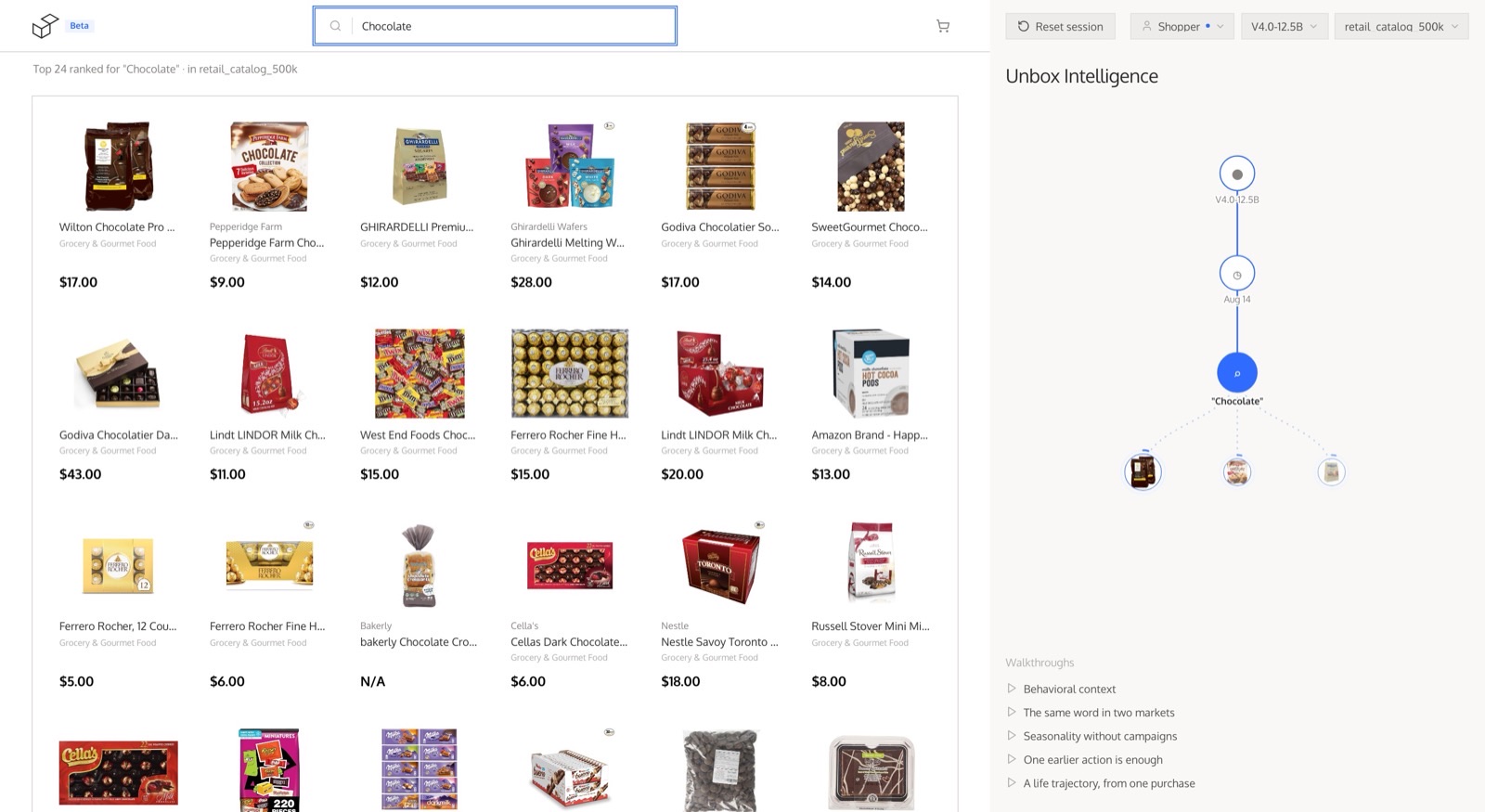
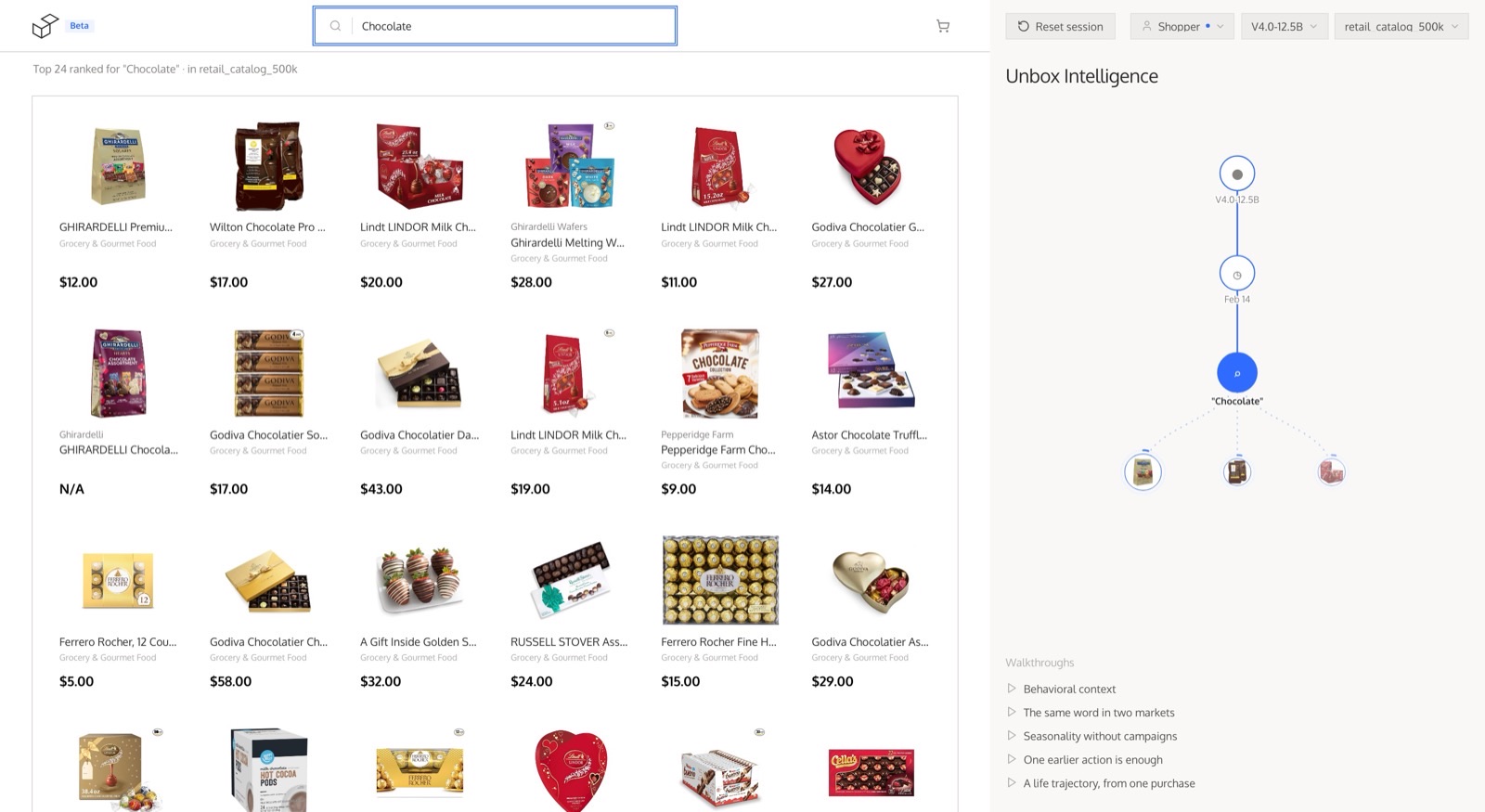
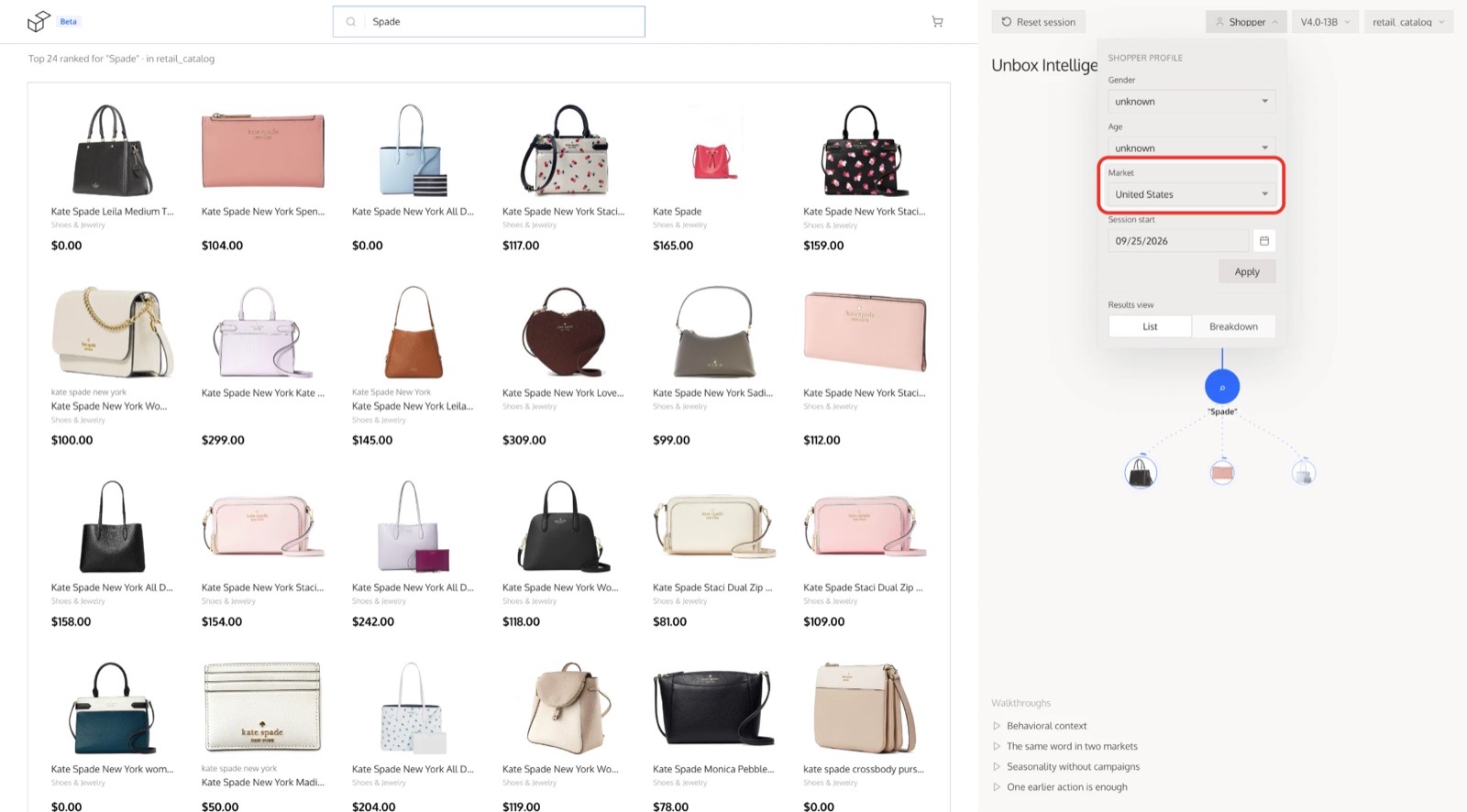
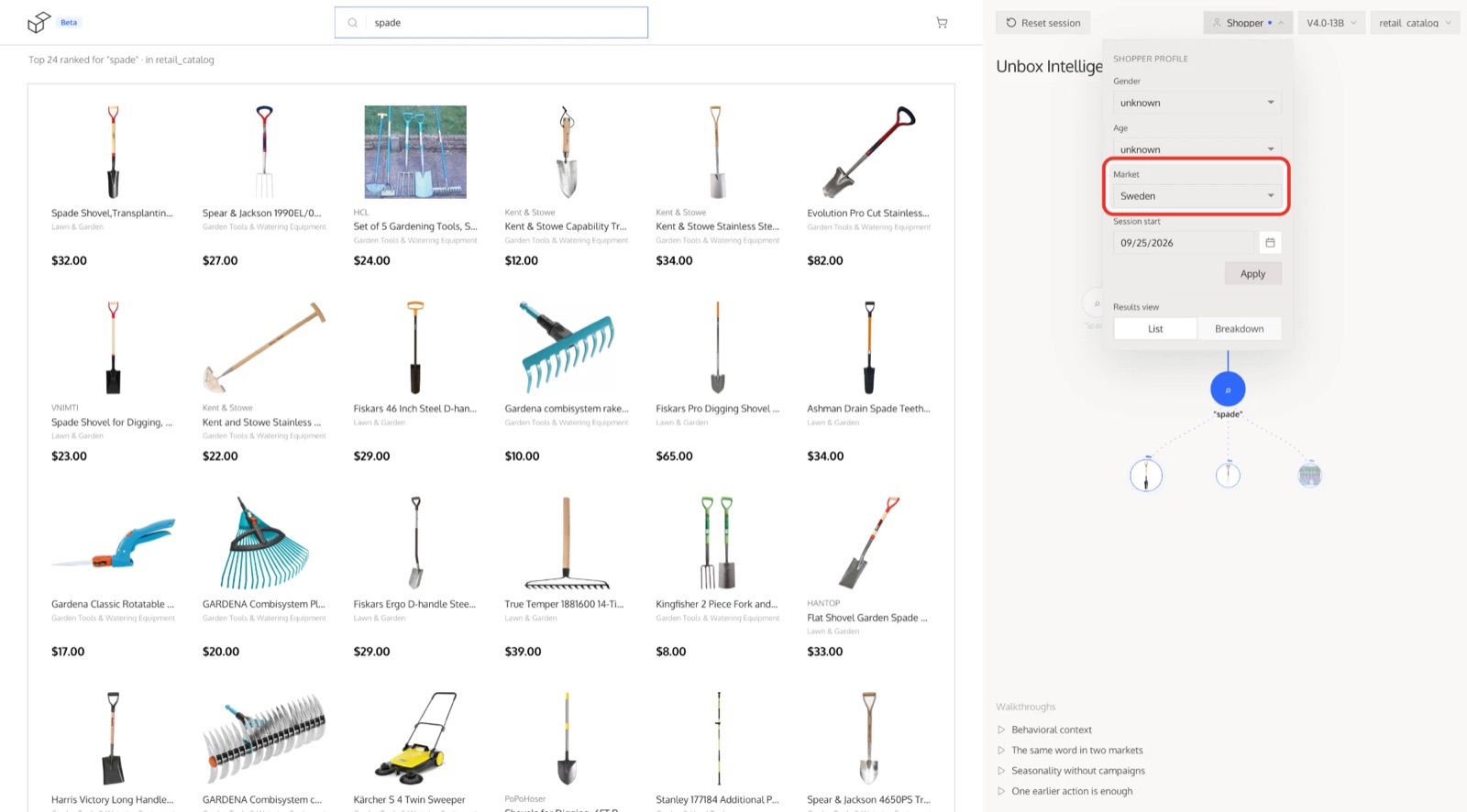
Context changes what a query means. The same search for chocolate returns everyday chocolate on an ordinary day and heart-shaped boxes on Valentine's Day (). The same search for spade returns Kate Spade handbags in the United States and garden spades in Sweden ().


Search results for chocolate on 14 August
14 August
Search results for chocolate on 14 February, showing heart-shaped boxes
14 February
The same query, chocolate, on two dates. Only the session date changes. On Valentine's Day the 12.5B ranks heart-shaped boxes and chocolate-dipped strawberries.

Search results for spade in the United States market: Kate Spade handbags
United States
Search results for spade in the Swedish market: garden spades
Sweden
The same query, spade, in two markets, on the 12.5B. Only the market changes.

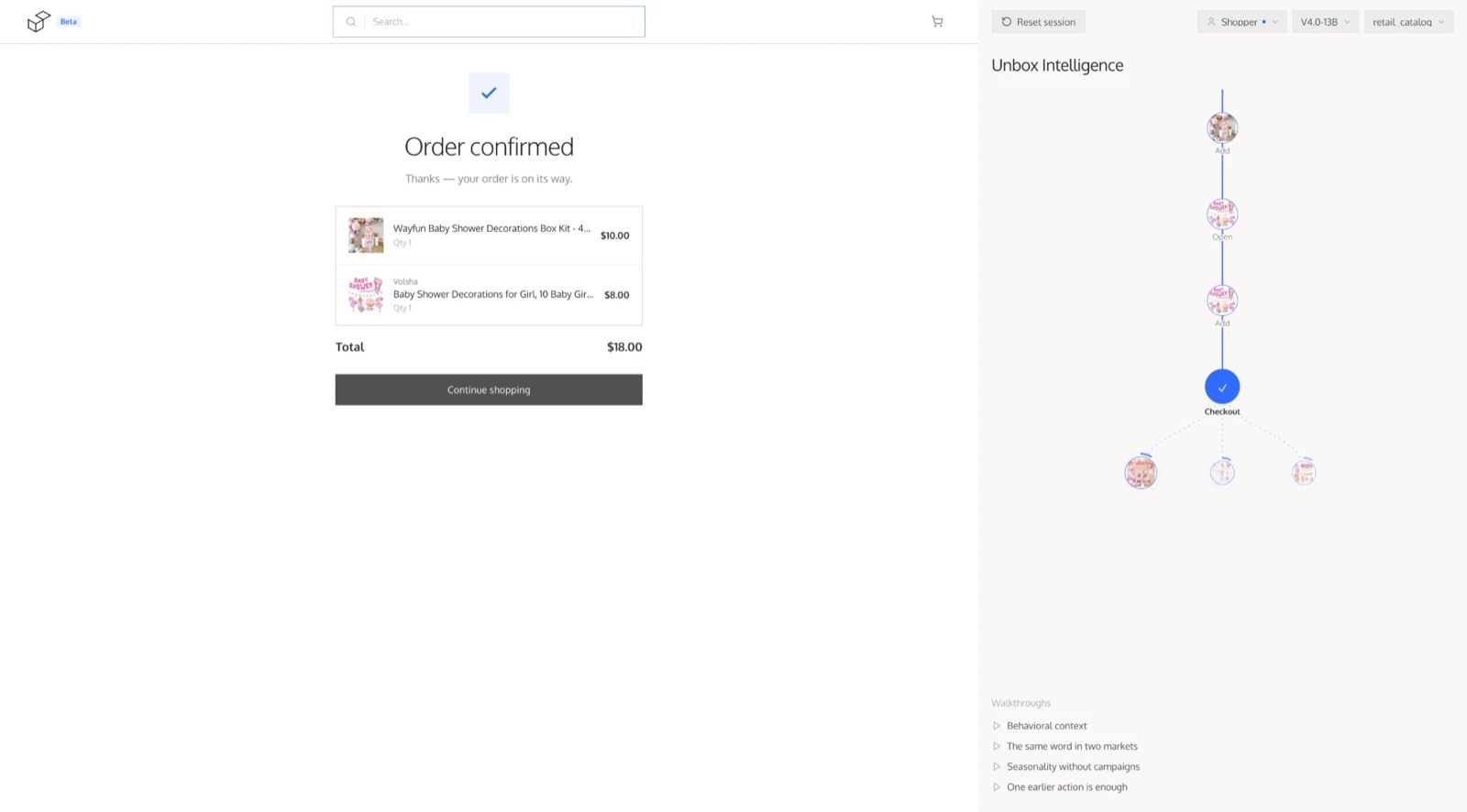
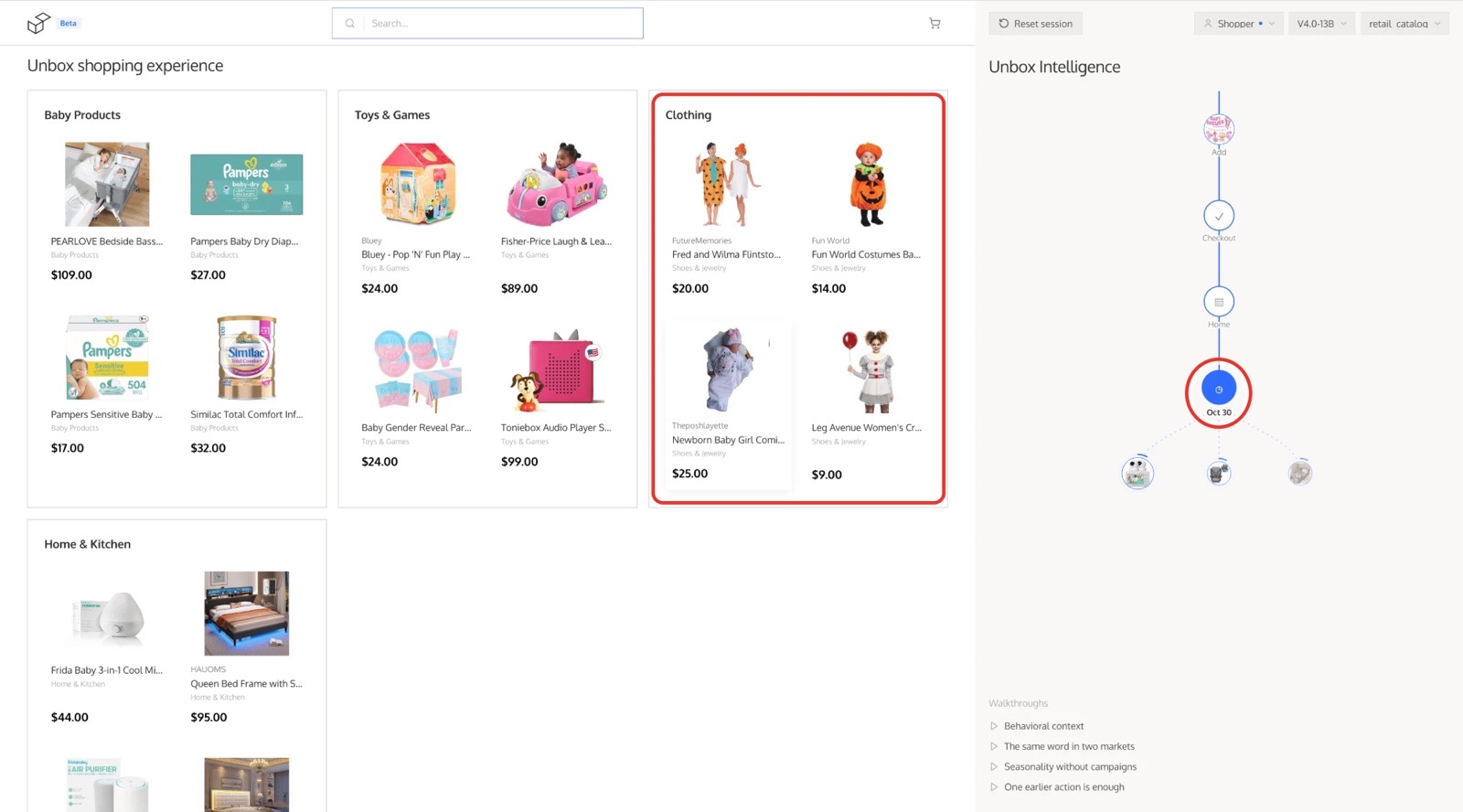
History and context combine. A shopper searches for baby shower in April, adds decorations, and checks out. With the session date moved to 30 October, the home page fills with infant products: a bassinet, diapers, formula, and toddler toys, with Halloween costumes among the clothing (). From the earlier purchase and the date, the model infers that the household probably now has an infant.


13 April: order confirmed for two baby-shower decorations
13 April: checkout
30 October: the home page shows baby products and Halloween costumes
30 October
One session on the 12.5B. A baby-shower purchase in April and a date in late October produce recommendations for an infant, with Halloween costumes alongside.

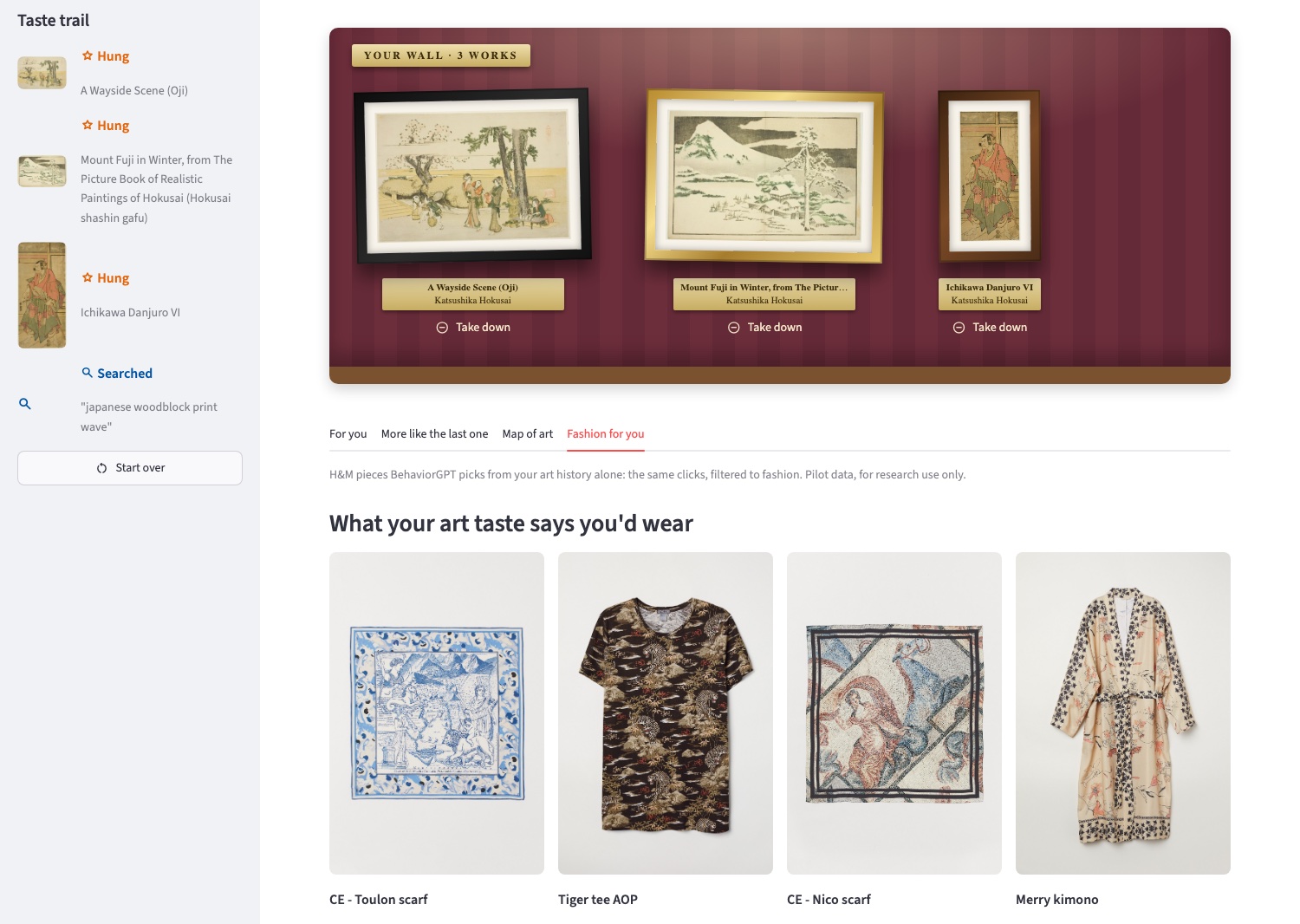
The same SDK supports applications beyond shopping. Curate my wall ranks 19,000 artworks from the Art Institute of Chicago, a catalog with no interaction data, served by the 12.5B with no task-specific training. With 19,000 H&M products added to the same catalog, a visitor's art history alone yields fashion recommendations. Someone drawn to Hokusai prints is shown kimonos and printed scarves (), though no event in their history involves clothing.


Curate my wall: three Hokusai prints hung, and H&M fashion recommended from that history
Fashion recommended from a history of art alone. The visitor searched for Japanese woodblock prints and hung three works by Hokusai.

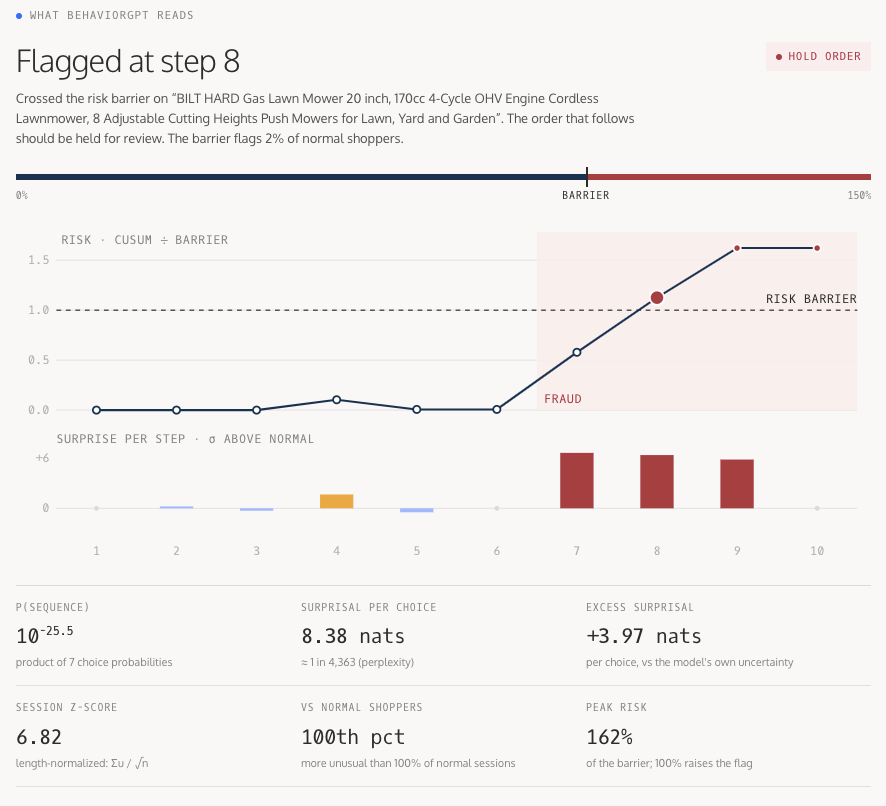
A third demo detects fraud with no labels. It scores each action by how much it surprises the model, accumulates the score over the session, and flags the session once it crosses a threshold set to flag 2% of normal shoppers. In one account takeover, the owner browses headphones; then someone else adds a phone, a gas lawn mower, and a crossbow. The session is flagged at step 8, before the order is placed, and the demo names the actions that raised the flag ().


Accumulated risk crosses the threshold at step 8 of an account takeover, before checkout
An account takeover flagged without labels. Steps 1–6 are the account owner; from step 7 someone else is shopping. Accumulated risk crosses the threshold at step 8.
SDK and API

Build with it

The 12.5B and 0.5B checkpoints are available through an SDK and API. Deploy any catalog and call ranking, retrieval, next-action prediction, and embedding extraction on it, for search, recommendations, or anything that consumes a ranking. An example notebook runs our zero-shot PixelRec evaluation through the public API.

Paper and team

Read more

The technical report covers the full evaluation protocol, every baseline, the training recipe, and the internal ablations behind each design choice. Two companion pieces cover the definition of Large Behavioral Models and compute-optimal scaling for this model family.

Contributors. Rickard Brüel-Gabrielsson, Vasudev Gupta, Tom Boustedt, Adam Fredriksson, Simon Granström, Marcel Rød, Gonçalo Marques, Jens Palmborg, Erik Guander, Nicolas Sanchez, Artem Lukoianov, Srijan Sood, Georgios Kolovos, Simon Ejdemyr, Toni Rosinol, Mattias Holmström, Marc Mathieu, Pratik Thakar, Wen Yao, Miguel Paredes, Peter Sarlin, Alexander Statnikov, John Brüel-Gabrielsson, Stephen P. Flinter, Bryan McCann, Sebastian Siemiatkowski, and Gunnar Carlsson. Individual contributions are listed in the paper.

Contact. rickard@unboxai.com

Cite

Citation

behaviorgpt-v4.bib
@techreport{unbox2026behaviorgptv4,
  author      = {Rickard {Br{\"u}el-Gabrielsson} and Vasudev Gupta and Tom Boustedt and Adam Fredriksson and Simon Granstr{\"o}m and Marcel R{\o}d and Gon{\c{c}}alo Marques and Jens Palmborg and Erik Guander and Nicolas Sanchez and Artem Lukoianov and Srijan Sood and Georgios Kolovos and Simon Ejdemyr and Toni Rosinol and Mattias Holmstr{\"o}m and Marc Mathieu and Pratik Thakar and Wen Yao and Miguel Paredes and Peter Sarlin and Alexander Statnikov and John {Br{\"u}el-Gabrielsson} and Stephen P. Flinter and Bryan McCann and Sebastian Siemiatkowski and Gunnar Carlsson},
  title       = {BehaviorGPT-v4: One Large Behavioral Model for Retail, Engagement, and Payments with Zero-Shot Transferability},
  institution = {Unbox AI},
  year        = {2026},
  month       = oct,
  url         = {https://research.unboxai.com/behaviorgpt-v4-one-large-behavioral-model.html},
}